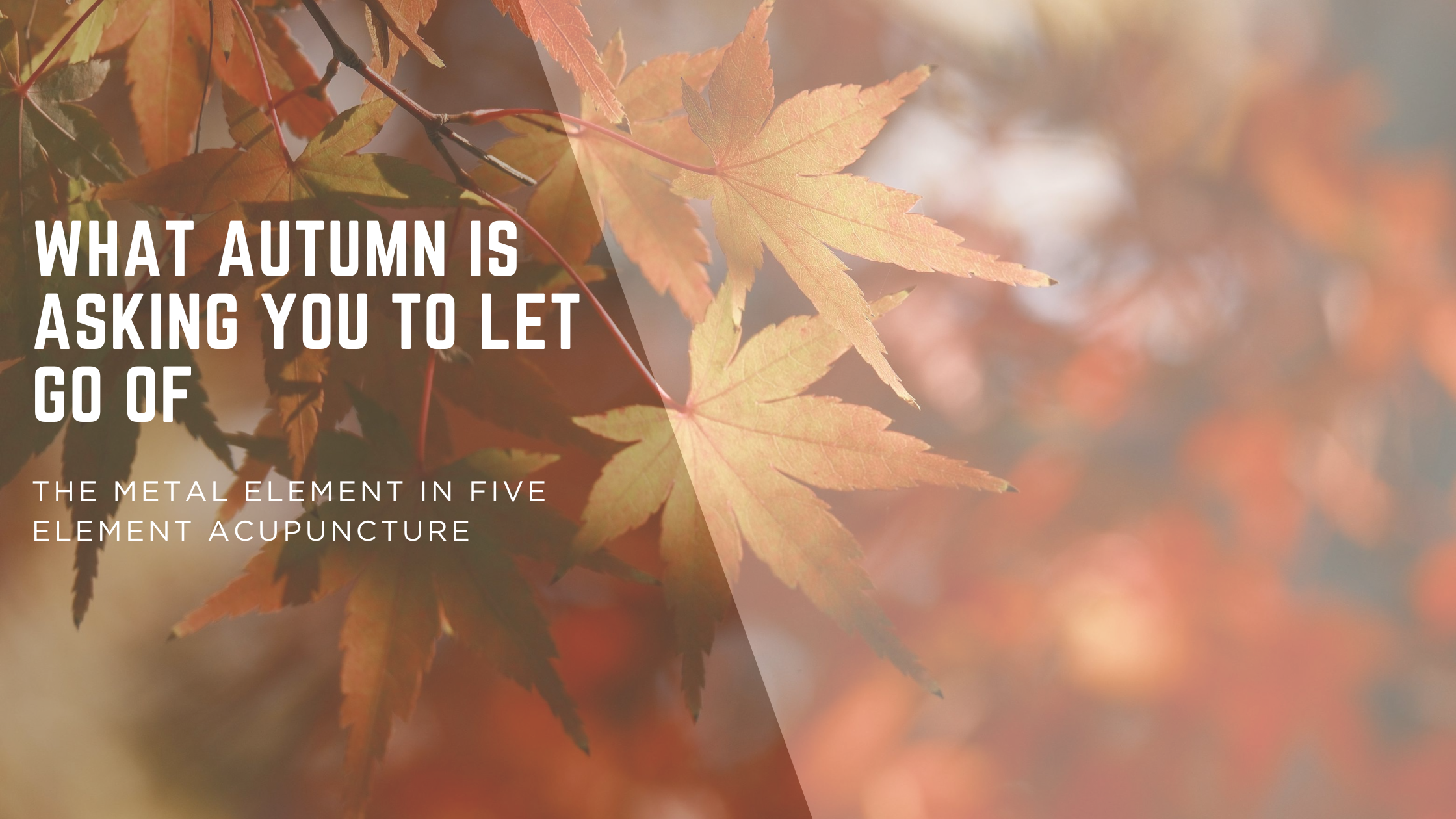
There’s a particular quality to October air that nothing else replicates. The light goes gold and slanted. Things that were green all summer start to let go of their chlorophyll, revealing the color that was underneath all along. In Five Element Chinese Medicine, this is Metal season — and it has something to teach us that most of us resist learning until life forces the lesson.
Metal governs the Lung and Large Intestine. Its tissues are skin and hair, its sense is smell, its emotion is grief. But the deeper function of Metal isn’t really about any of those things individually — it’s about a single, continuous motion: taking in what has value, and releasing what doesn’t.
Every breath does this. You inhale, you extract what’s useful, you exhale the rest. The Large Intestine does this too, on a different timescale — absorb, then release. It’s what lets you recognize value, hold onto it, and let everything else go.
The Po: What Grief Is Actually For
In 5 element acupuncture— the spirit housed in the Lung is called the Po. The Po’s job is to draw things toward your center and downward and hold them there. It’s instinctive, bodily, almost animal in its wisdom. And its native emotion is grief.
We tend to treat grief as something that happens to us when we lose something we wanted to keep. But in this model, grief isn’t a malfunction — it’s the Po doing exactly what it’s built to do. You held something. It mattered. Now it’s gone, and your body is processing that absence the way skin processes a wound: not instantly, but correctly, in its own time.
The problem isn’t grief itself. The problem is what happens when we can’t complete the cycle — when we keep holding onto something the Po has already tried to release.
Two Ways Metal Goes Sideways
Excess Metal sounds like: what I value must be held onto no matter what it costs me. This is the clenched fist. The relationship you won’t exit because you’ve already invested five years. The old text thread you keep checking, hoping it says something different this time. The identity you built that no longer fits but still feels safer than the alternative.
Deficient Metal sounds like: nothing of value can really be attained or held. This is the open hand that’s stopped reaching. A kind of low-grade grief that colors everything — a sense that even good things won’t stick, so why bother holding tightly to anything at all.
Both patterns are trying to solve the same problem — how do I relate to value and loss — and both end up a little stuck. Healthy Metal sits in the middle: hold what’s real, release what’s spent, and trust that letting go makes room for the next thing to arrive.
The Question Underneath the Question
One of the most useful reframes I come back to with clients — and with myself — is this: self-worth is a Metal function, distinct from self-esteem, which belongs to Wood. Self-esteem asks “do I feel good about what I did.” Self-worth asks something quieter and more foundational: “is my value here regardless of what I did or didn’t accomplish today.”
A lot of us have those reversed. We let our worth float on the tide of our productivity, our last good interaction, how someone responded to a text. Metal asks a different question: what do I need to receive in order to let go? And what do I need to let go of in order to receive?
Try sitting with that for a minute before you keep reading. It’s not rhetorical.
Healthy Emptiness
Here’s the part people find hardest to hear, so I try to say it gently: some emptiness is not a problem to be fixed. It’s the space autumn makes on purpose.
Trees don’t hold their leaves because they’re afraid of bare branches. They let go because bare branches are what makes spring possible. If you’ve ever felt a void that no material gain seems able to fill — more achievement, more approval, more stuff — that void might not be asking you to fill it faster. It might be asking you to stop mistaking it for a wound and start recognizing it as room.
This is something I sit with often in treatment room conversations, whether I’m working with someone in my Kingston clinic or at the Gananoque location — that ache of “nothing feels like it’s landing” is frequently a Metal-constitution pattern, not a personal failing. Naming it changes the relationship to it almost immediately.
A Few Questions to Sit With This Season
If any of this is resonating, here are a few prompts drawn from the Metal reflections I share with patients:
- When someone doesn’t respond the way you hoped — a friend’s silence, a partner’s sharp tone — is that actually about you, or is it the story you’re most practiced at telling?
- Where do you make absolute statements about your worth? “I am not worthy” versus “a part of me feels unworthy” are two very different sentences.
- What are you doing out of habit that you’d never choose if you were starting today?
- Are you still checking something — an old thread, an ex’s social media, an inbox — hoping it will finally say something different?
- If you could only keep three commitments on your calendar this month, would the ones you currently have make the cut?
None of these have tidy answers. That’s the point. Metal doesn’t want you to resolve the question quickly — it wants you to sit in the refining fire of it long enough that what’s false burns off and what’s real becomes visible.
Closing Thought
Autumn will keep doing what autumn does, whether or not we cooperate. The trees aren’t asking permission to lose their leaves. But we get to choose whether we fight that same motion in ourselves or let it teach us something.
If this kind of reflection speaks to you, it’s often exactly the terrain we work with in session — the body holds these patterns somatically long before the mind has language for them. I’d love to support you through this season, whether that’s a conversation or a treatment. You can find me at Warrior Spirit Healing Arts in Kingston or Gananoque, and I’m always glad to talk through what Metal season might be asking of you specifically.
